Showing posts with label japan. Show all posts
Sunday, November 18, 2018
Modern Day Crinoids
In July 2018, I visited the American Museum of Natural History in New York City, USA. While there I came across the Hall of Biodiversity and the variety of preserved crinoids. First image is a Metacrinus rotundus crinoid found in the Pacific Ocean. The second crinoid is an Antedon sp. found near Misaki, Japan.
This last crinoid is Metacrinus rotundus crinoid found in the Pacific Ocean.
Images take July 2018.
Tuesday, September 9, 2014
Subptychoceras yubarensis and Gaudryceras Ammonite Fossils
Here is a picture of two ammonite fossils Subptychoceras yubarensis and Gaudryceras sp. at the Museo di Paleontologia at Sapienza University of Rome Italy. Creatures like this existed at the time of the upper/late Cretaceous Period (ICS geological timescale: Santonian). Fossil was found in Japan.
Image taken in June 2014.
Labels:
ammonite,
Cretaceous,
japan,
sapienza university of rome
Monday, January 28, 2013
Cipangopaludina Snail
Cipangopaludiana japonica? snail found in the Potomac River outside of Washington, D.C. It is not a native species of the United States but found its way here from Asia. I have posted about this snail before but those were found in the White River of Indianapolis, Indiana. See that entry from November 15, 2010. The specimen was cleaned up and I posted it on April 2, 2011, see post here.
I wonder if this snail is edible. There is a show on Korean television (KBS) called Screening Humanity. They profile different households around Korea every week. One older couple who lived in the countryside was shown preparing marsh snail soup. It looks like the snails are soaked in clean water and then boiled later. A needle is then used to extract the snail out of the shell. I am not sure what is next in the recipe as they did not show that part on the show.
The two specimens shown in this posting have been cleaned.
Thanks to Kenny for specimens.
Smaller specimen shown.
Labels:
china,
gastropod,
japan,
snail,
washington dc
Monday, November 15, 2010
Cipangopaludina japonica River Snail
This is not a fossil but it could be one day. Snail shells found in the White River of Indianapolis, Indiana. Some how this Asian snail has gotten loose in the river and is multiplying. I found 6 shells on a 5 meter stretch of river bank. A naturalist at the Indiana State Museum identified it as maybe a Cipangopaludina japonica.
Two specimens are shown in these images. The largest is 5.2 cm long, 4.0 cm wide, and 3.8 cm tall. I wonder if these creatures are edible?
In addition, I found two types of river bivalves and two other types of smaller snails.
Two specimens are shown in these images. The largest is 5.2 cm long, 4.0 cm wide, and 3.8 cm tall. I wonder if these creatures are edible?
In addition, I found two types of river bivalves and two other types of smaller snails.
Labels:
indianapolis,
japan,
snail
Monday, August 30, 2010
Japanese Shark Teeth Web Site
My knowledge of shark teeth fossils is very limited so finding this Internet site in Japan is a real treasure: J-elasmo by Dr. Fumio Nakagawa (Ota-ku, Tokyo).
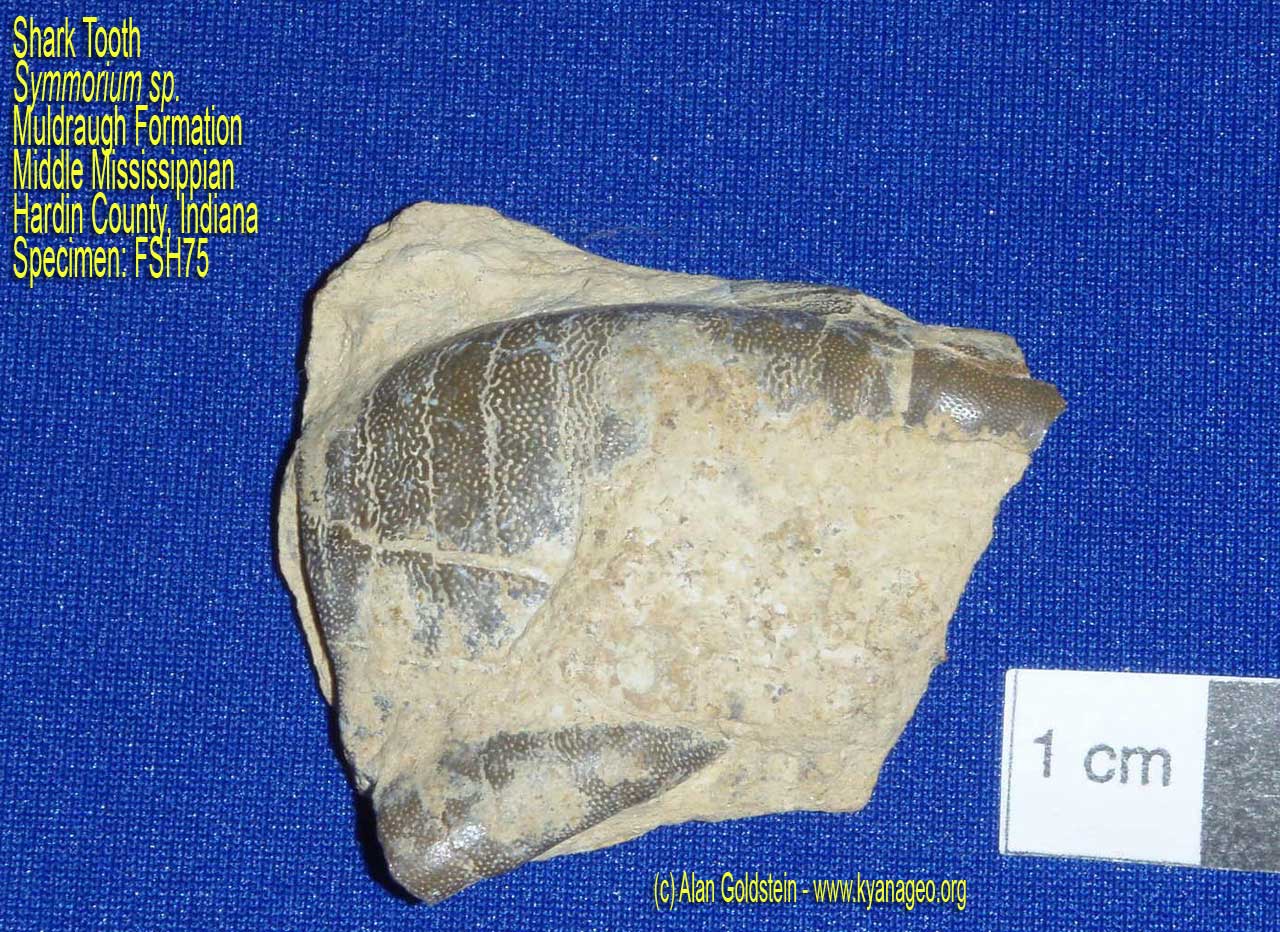
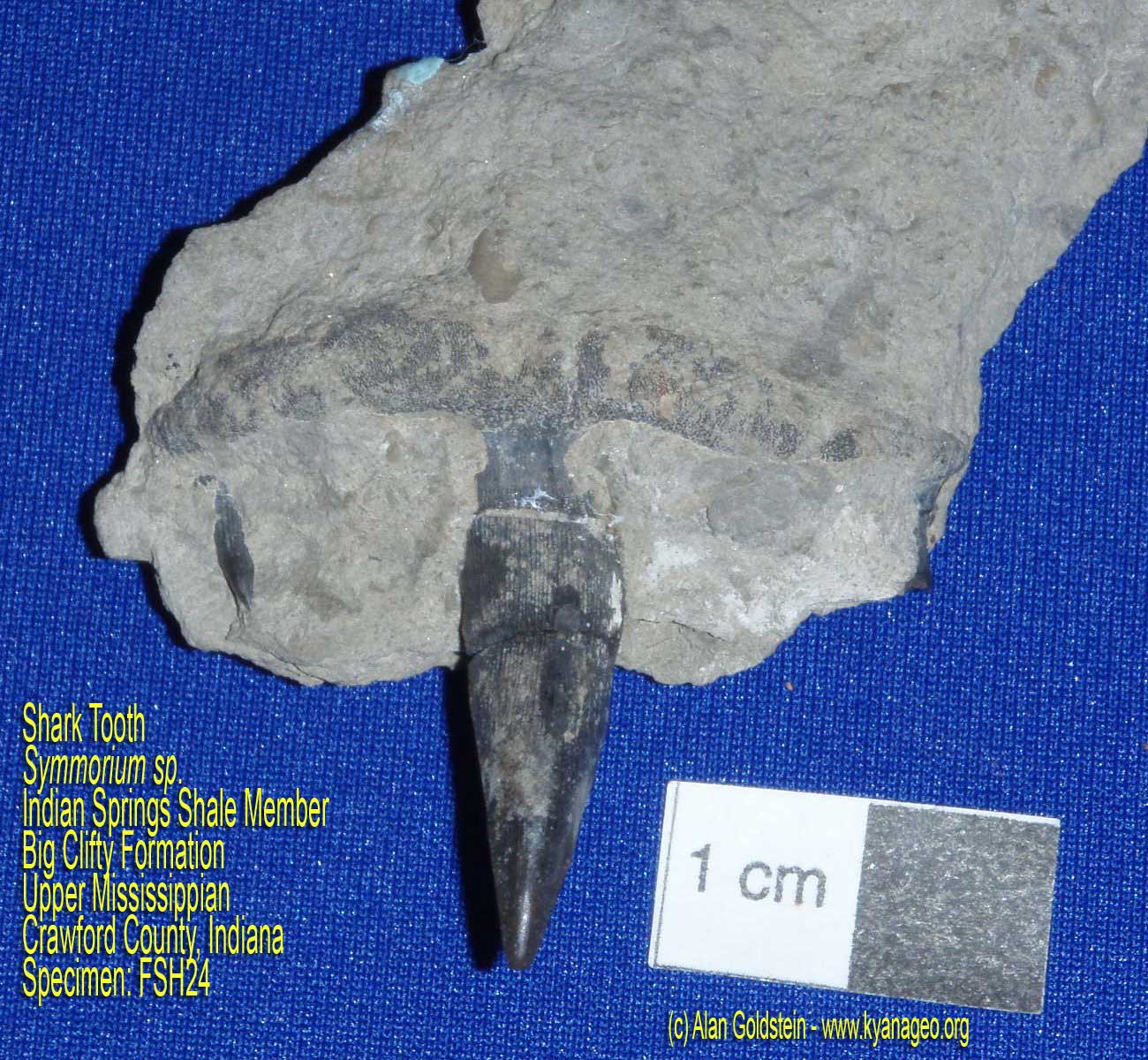
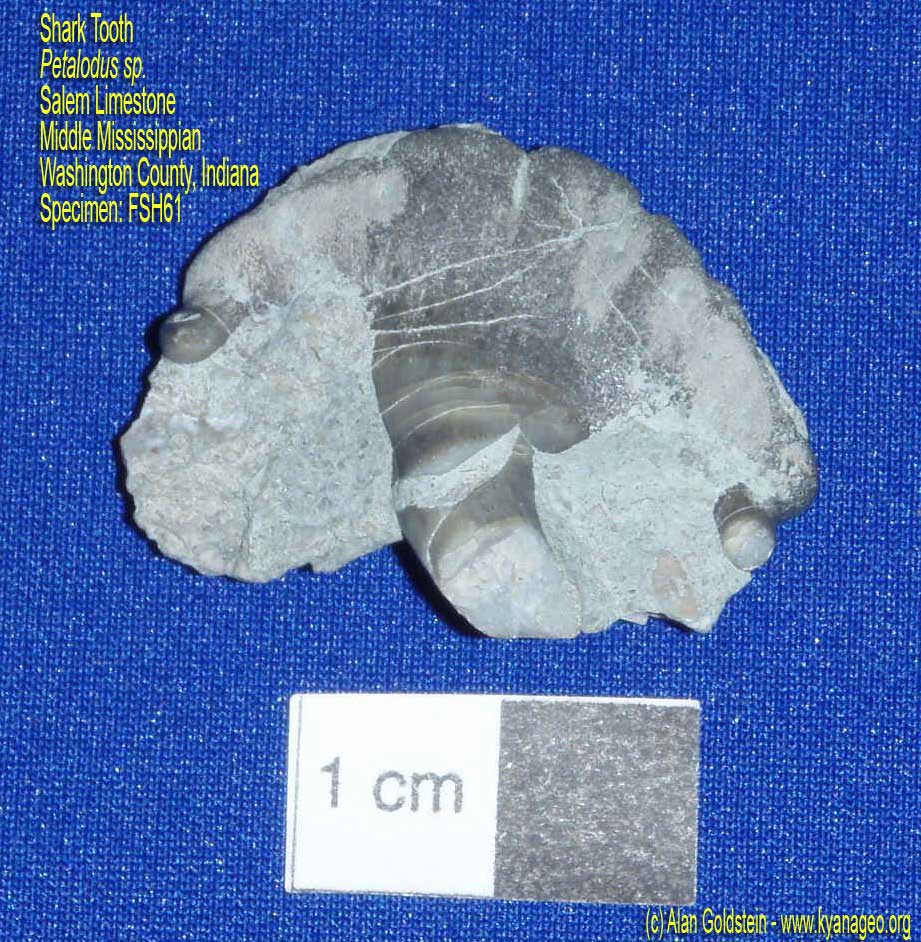
It is good to set objectives and two of my current ones are: 1) find a Troosticrinus (Shumard, 1866) blastoid and 2) collect a Mississippian Period shark tooth. This web site can help with the second objective in providing images of what to look for and which layers to find the fossil. Wow, the collection of Indiana and Kentucky Mississippian Period shark teeth is impressive!
Symmorium
Stethacanthid Shark - Mississippian Period
Drawn by Dmitry Bogdanov
Courtesy of Wikipedia Commons
Three web pages on the site were of particular interest. Mississippian Period fossil teeth found in three Indiana locations on this page. The first site is in Washington County, Indiana in the Harrods Limestone Formation with Symmorium, Hybodus, Orodus greggi, Petalodus, Polyrhizodus, Lisgodus, Chomatodus multiplicatus, Helodus, Deltodus, Lagarodus, Venustodus argutus, and Phoebodus specimens being found.
Site 2 is also in Washington County, Indiana in the Salem Limestone. Specimens found there are: Chomatodus, Antliodus, Campodus, Sandolodus, and Psammodus.
Site 3 found in Washington County, Indiana in the Haney Limestone Formation. Specimens Symmorium and Chomatodus being found.
The next web page lists more Upper Mississippian Period shark teeth but this time from Crawford County, Indiana. Specimens found in the Haney Formation: Symmorium, Hybodus, Orodus, Campodus, Petalodus, Fissodus, Tanodus polymorphus, Helodus, Sandolodus carbonarias, Psammodus, and Venustodus. Found in the Indian Springs Formation: Symmorium reniforme, Antliodus, Arpagodus, Venustodus argutus, Petrodus, Sandlodus, and Deltodus.
The last web page is of Middle Mississippian Period sharks teeth found in Hardin County, Kentucky. These teeth were found in the Salem/Harrodsburg Limestone. Identified as Campodus, Hybodus, Orodus, Phoebodus, Chomatodus multiplicatus, Helodus, Sandolodus, and Psammodus.
This website is a treasure trove of pictures of fossil sharks teeth found in Indiana and Kentucky. Those images represent just a small fraction of the information about sharks on this impressive web site.
Here are links to locally collected shark teeth posted on the KYANA Geological Society web site:
http://www.kyanageo.org/Fossils/mississippian/vertebrata/4670---Petalodus-acuminatus.jpg
http://www.kyanageo.org/Fossils/mississippian/vertebrata/FSH75_Petalodus.jpg
http://www.kyanageo.org/Fossils/mississippian/vertebrata/FSH24_Symmorium.jpg
http://www.kyanageo.org/Fossils/mississippian/vertebrata/FSH61_Symmorium.jpg
UPDATE (9/7/2019): Changed web address for Japanese site that changed hosts.
Labels:
indiana,
japan,
Kentucky,
mississippian,
shark tooth
Subscribe to:
Posts (Atom)