Showing posts with label Lake Cumberland. Show all posts

Wednesday, April 21, 2021

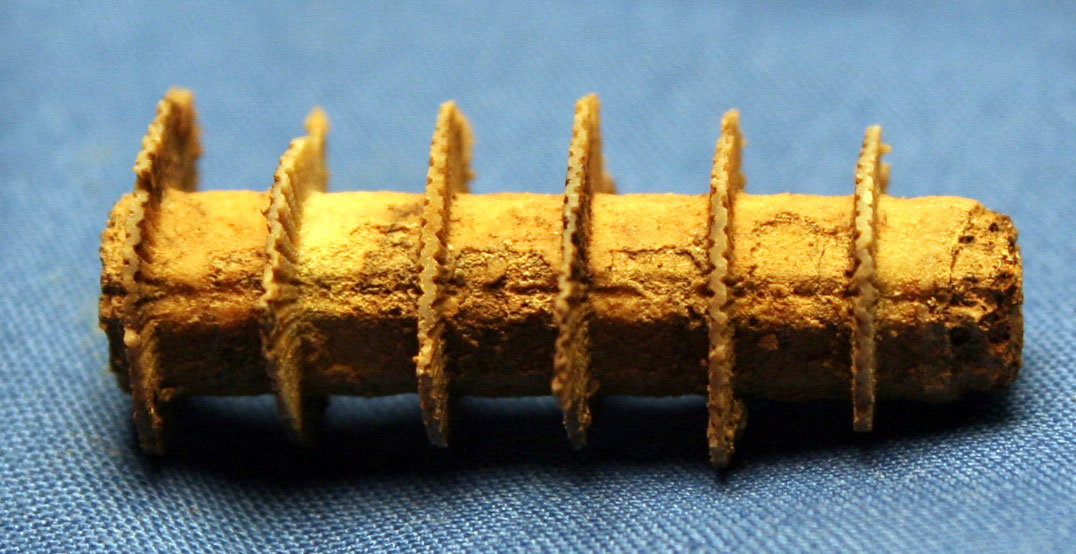
Crinoid Fossil Column Section


This crinoid fossil was collected in 2009 at Lake Cumberland Kentucky USA. It dates to the Mississippian Period and was found in the Fort Payne Formation. Recently, I had it out to test a new ultrasonic cleaner.


Thursday, April 2, 2020

Actinocrinites Crinoid Calyx Fossil


Over 10 years ago, a crinoid plate was found at Fort Payne Formation of Lake Cumberland Kentucky, USA. It is an interesting find in that the broken apart crinoid calyx can be seen on both sides of the plate. Also the plates have such a distinct and pronounced pattern. After showing this to my cousin Kenny, he determined the crinoid remains appear to be an unknown species of the genus Actinocrinites. The plate is about 17 cm long and 13 cm wide at maximum lengths. The individual plates are about 1.5 to 2 cm in diameter.


Friday, December 3, 2010

Eroded Crinoid Stem


An eroded fossilized crinoid stem found in the Fort Payne Formation of Lake Cumberland, Kentucky.  Crinoid existed in the Mississippian Period.


Saturday, November 6, 2010

Unidentified Mississippian Period Crinoid Calyx

Unidentified crinoid calyx found recently at Lake Cumberland, Kentucky.  Fossil dates to Mississippian Period and found in the Fort Payne Formation.


Thanks to Herb for letting me photograph this fossil.

Saturday, December 12, 2009

Lower Carboniferous Crinoid Calyx

Here are various pictures of Lower Carboniferous Period (Mississippian) crinoid calyx from Fort Payne Formation of Lake Cumberland, Kentucky. They appear to be Eretmocrinus crinoids but some of the fragmented pieces I am not sure.

Always a delight to find the calyx, of course finding the stem and arms attached would be a real treat but were not in Crawfordsville anymore, Toto.


Friday, December 11, 2009

Mississippian Period Trilobite Pygidium

Rare is a find than that of a trilobite fragment in the Mississippian Period (Lower Carboniferous - 359 to 318 million years ago) Fort Payne Formation of Lake Cumberland, Kentucky. This picture is of such a find that being a trilobite pygidium found in a gray rock shale with a lot of compressed Fenestella like bryozoan pieces.

This specimen is quite small and hard to get a detailed image of. It is about 1.5 cm wide. Looking at the article in the Journal of Paleontology, November 1966 entitled "Mississippian Trilobites from Northwestern Georgia" by Mark Rich of the University of Georgia in Athens, two trilobite genus are mentioned being in the Fort Payne Chert: Australosutra and Proetus.  I am not familiar with the Australosutra trilobite and do not see one in the Google Image database.  The Proetus trilobite has more of a bubble like hump in the middle lobe of the pygidium so it might not be that genus.  Next time I am on JSTOR I will try and look at that article and see if the images look anything like this one.


Tuesday, September 15, 2009

Carboniferous Fossils

The following are images of Lower Carboniferous Period (Mississippian) fossils. This first one is a elliptical crinoid columnal segment from maybe a Platycrinites.

This next image of a crinoid calyx that is probably an Eretmocrinus.

This next image is of an anal tube of an Eretmocrinus crinoid.
This might be a holdfast of an unidentified crinoid.


Unknown brachiopod shell half fossil.


A view of Lake Cumberland, Kentucky where these fossils were found in the Fort Payne Formation.

Sunday, July 12, 2009

Modern Day Crinoid

Yesterday, I got to tour the Indiana University Southeast Geosciences Department. Toward the end of our tour, we went into one of the labs and one the shelf was a jar with a clear preservative. In the jar was this white crinoid which were told was found in about 400 feet of water off the coast of Florida. It was interesting to see a creature that usually is only found as fossil.

Some of the images are not too clear since I had low lighting and was taking pictures through a jar filled with liquid.


(UPDATED: 09/12/2010)
Here are pictures of a modern day sea lily/crinoid (Metacrinus rotundus) of the phylum Echinodermata.  Pictures taken in August 2010 at the Smithsonian Museum of Natural History in Washington, D.C.


I include some pictures for Mississippian Period (Lower Carboniferous) crinoid stems from the Fort Payne Formation located at Lake Cumberland, Kentucky.


Tuesday, April 21, 2009

Blue Fossils of Lake Cumberland Kentucky

The fossils of Lake Cumberland, Kentucky that have a blue color. Three of these pictures have blue crinoid stem pieces and the fourth is part of blue brachiopod shell.

I need to find a source to describe maybe what species these are and why they are this blue color.


Saturday, March 28, 2009

Blue Brachiopods Shell Fragments from Lake Cumberland, Kentucky

Here are some fragments of brachiopod shells from the Mississippian period. They are from the Lake Cumberland, Kentucky region. Mixed in with crionoid fragments they are part of the Fort Payne formation.

The shells are not quite as worn as ones from earlier posts.


Tuesday, March 24, 2009

Blue Brachiopod Fossils from Lake Cumberland, Kentucky

This shell is quite worn of a brachiopod found at Lake Cumberland, Kentucky.

The fossils are usually blue but this one is more light blue.