On December 3 2017 12:12 PM EST James Elvin Conkin passed away at the age of 93. He was born October 14, 1924, in Glasgow, Kentucky, USA to Rachel Pauline (Hicks) and Basil Conkin.
From what I can tell, he had a full and productive life through raising a family, teaching at the University of Louisville for 44 years and traveling the world. Image above was taken March 2012. His obituary can be found at this
legacy.com link.
I cannot recall when I first met Dr. James Conkin, a retired geology professor from the University of Louisville. If I remember, it was during his visit to Falls of the Ohio State Park fossil festival where he had a table where he sold his publications on paleontology. Some how or the other I started helping him photograph some of his microfossils for new publications he wanted to work on.
Here is a link about one of those documents:
http://louisvillefossils.blogspot.com/2012/04/chinese-foraminifera-carboniferous.html and it was followed with a 2012 Louisville Studies in Paleontology and Stratigraphy No. 23
Reconnaissance Studies of Paleozoic Foraminifera from China: Part 2 - The Middle Devonian and Carboniferous-Permian of Hunan, Guizhou, and Jiangsu.
 |
| Hunting for charophyte fossils in Louisville September 2011 |
Dr. Conkin gave me new insights on very small fossils called foraminiferas and
charophytes. His last lesson for me was as you grow old, still maintain a curiosity of the world around you.
I will end this tribute with a quote from Dr. Conkin's 2006 book "I SEE... WONDERFUL THINGS".
Yet this celebration of enlightened ignorance is one with an eventual dreadful ending, both individually and collectively, but glorious until that time of the death of the individual or of our star system, or indeed all space and time. Let us rejoice until then in those "wonderful things" we see and in the old, old stories they tell as we continue to learn more and more of their "spoken babbles." Even the rocks themselves "sign." Though a complete mastery of all their divers formal tongues, dialects, and patois is unattainable, we can, nevertheless, revel in their exquisite syntaxial beauty and eloquence, even though only for our life's ephemeral tenure.
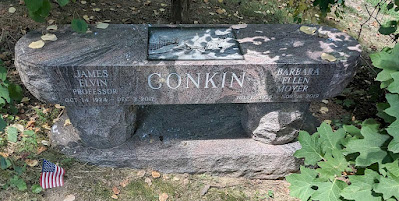 |
| James and Barbara Conkin grave stone at Cave Hill Cemetery in Louisville Kentucky USA as July 2023 |
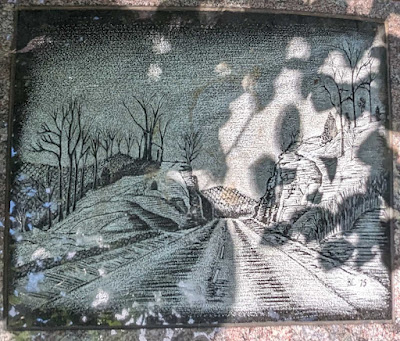 |
Barbara Conkin 1975 sketch on the top of grave stone
|


