Wednesday, February 17, 2010

A Tale of Two Corals

Here is a closeup of a Foerstephyllum (Bassler, 1941) colonial coral fossil for the Upper Ordovician Period. It was found in Louisville, Kentucky. Notice the septa lines in individual coral cells.  These Kentucky fossils are quite beautiful and it is very nice when you can find them with exposed septa. The genus was named by Ray Bassler (1878-1961) to honor Ohio born Dr. August Foerste (1862-1936) Harvard educated paleontologist, geologist at United States Geological Survey (USGS) and high school science teacher.


These next two pictures are of another Upper Ordovician Period colonial coral fossil found with the previous fossil.  Its cell walls are in a different pattern.

UPDATE (3/1/2026): This coral appears to be a Calapoecia huronensis (Billings, 1865). See the Wooster Geologists blog for more information about it.


Tuesday, February 16, 2010

Blastoid Microfossil?

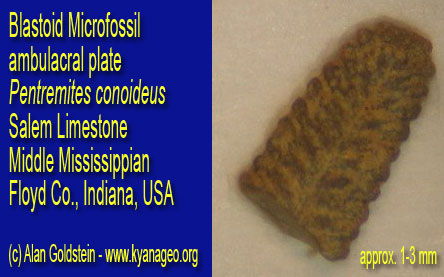
I am basing this identification off a picture on the KYANA Geological Society website (http://www.kyanageo.org/Fossils/mississippian/echinodermata/pentremites-conoideus.jpg). It is of a Pentremites conoideus blastoid in the Salem Limestone of Floyd County, Indiana. It is from the Middle Mississippian Period. The two pictures shown here are of a fossil from the Salem Limestone of Washington County, Indiana. 


Monday, February 15, 2010

Peneroplis Foraminifera from Spain

Images of two different specimens for a foraminifera called Peneroplis planatus. These remains were found on Levante Beach, Benidorm, Spain. The creatures exist in present time.  Images taken with a Kodak Easyshare LS273 camera using an Orion microscope at 40x magnification.  While the microscope does not have model number on it, I believe it is the S400 which is listed on amazon.com for about $60.

 
Thanks to Michael Hesemann for the specimens and his great website that makes identifications a much easier task.