Wednesday, January 5, 2011

Pea Sized Waldron Shale Fossil


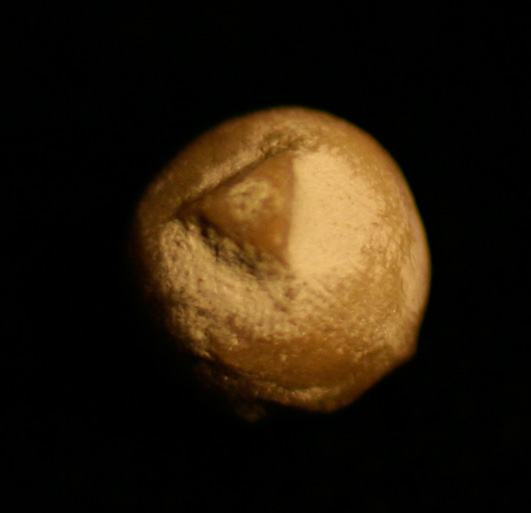
This post shows a series a pictures of a small pea sized (3-6 mm) fossil found in the Silurian Period Waldron Shale of southern Indiana.  Is this some sort of small calyx, blastoid, or something else?

The top has a small 5 petal flower like pattern that reminds me of crinoid calyx.  It sort of reminds me of a Pisocrinus crinoid but the base is circle enclosed in a triangle shape on these fossils.  The tops on some of the fossils have points the bend inward which seems more like a blastoid.

If anyone has some identification ideas on these fossils, let me know.  Thanks!

UPDATE (1/7/2011): After reading some great comments about these specimens, I e-mailed Dr. Colin Sumrall at the University of Tennessee in Knoxville for advice.  He identified it as a member of  the Coronoidea and it is called Stephanocrinus gemmiformis.  It is somewhat of a confusing crinoid and he pointed out it is "basically a blastoid with erect arms".

The Paleontological Research Institution (PRI) of Ithaca, New York has picture of an adult Stephanocrinus (PRI 42977) of the Rochester Shale on their web site.  They note it was thought to be a blastoid but "lacks the food grooves and central mouth that blastoids have".  While it is rare in the Waldron Shale of Indiana and maybe more common in Tennessee Silurian exposures, PRI lists it is common in the Rochester Shale of New York.  As of this writing Indiana9Fossils is selling at least one specimen here.


Kenny has found some of these fossils as well and sent me some images he took with a microscope.  One can see a line like pattern on parts of the fossil plus a magnified view of the triangle shape on the fossil bottom.


Tuesday, January 4, 2011

Paleontology and Dinosaur Hunting Radio Show


Louisville, Kentucky's news and talk public radio station WFPL (89.3 FM) local affairs program State of Affairs with host Julie Kredens will explore the topic of dinosaur fossil hunting on Thursday, January 6, 2011.

The radio show airs between 1-2 PM EST.  Thursday's show is entitled "Paleontology & Dinosaur Hunting" with guests Homer Hickam author of the novel The Dinosaur Hunter and Rocket Boys (book that inspired the movie October Sky) and paleontologist Jack Horner co-author of How to Build a Dinosaur: Extinction Doesn't Have to Be Forever and technical advisor on some of the Jurassic Park films.  Mr. Horner was recently interviewed for the CBS news show 60 Minutes, visit this web link.


If you are interested in dinosaurs, consider attending the free lecture on February 10, 2011 at 7:30 PM on the campus of the University of Kentucky in Lexington at the Singletary Center for the Arts building.  Jack Horner will be talking about his book on re-creating dinosaurs.  Learn more at this web link or view the PDF poster here.

UPDATE (7/8/2018): State of Affairs is no longer a program on WFPL. It ended its 14 year run in 2011. A recording of the show can be found on the WFPL News Archive Site at a link entitled Adventures in Paleontology by Laura Ellis.

Visit the WFPL web page for State of Affairs for a link to listen live if outside the Louisville, Kentucky broadcast area or the podcast once the show has aired.  E-mail questions to soa@wfpl.org or call in questions during the show at (502) 814-8255 or 877-814-8255.

The two life like dinosaur pictures were taken in 2010 at the Louisville Zoo's Dinosaurs Alive! exhibit and the dinosaur fossil casts picture was taken at the Museum of Natural History in Paris, France in 2009.

Sea Urchin Fossil from Mammoth Cave

The state of Kentucky is famous for longest known cave system in the world called Mammoth Cave.  The cave is thought to have begun forming about 10 million years ago.  Located in Edmonson County, the cave system has over 350 miles of surveyed passages.  A national park preserves the cave for visitors to explore and enjoy.  Visit their web site as this link.

This sea urchin fossil was found there and has been identified as a Melonechinus indianensis from the Mississippian Period.  The stratigraphy found at Mammoth Cave are: Girkin Formation, St. Genevieve Limestone and St. Louis Limestone.  Other fossils found at the cave include shark teeth, blastoids, crinoids, horn corals, brachiopods, and snails.  Since it is a national park, collecting is prohibited!

The fossil pictured in this post was on display in 2010 at the Smithsonian National Museum of Natural History.