This fragment shows a mold and some of the shell replaced by brown calcite of the glabella of a Cryptolithus trilobite. The fossil was found in the Kope Formation of Carroll County, Kentucky. The trilobite lived in the Ordovician Period.
Thursday, August 12, 2010
Tear Shaped Glabella
This fragment shows a mold and some of the shell replaced by brown calcite of the glabella of a Cryptolithus trilobite. The fossil was found in the Kope Formation of Carroll County, Kentucky. The trilobite lived in the Ordovician Period.
Labels:
cryptolithus,
Kentucky,
kope formation,
ordovician,
Trilobite
Wednesday, August 11, 2010
Importance of Fossil Labeling
Here is a two part video on the importance of the fossil labeling. The presentation was given at a Dry Dredgers meeting (Cincinnati, Ohio, USA). The presenter is John Tate who is a volunteer at the Cincinnati Museum of Natural History and Dry Dredger member.
Ouch, I am guilty of not labeling all my fossils though I am trying to get better. Lots of good advice in the video and I can relate to curating issues of trying to figure out specimens with poor or no labels.
They appear to have a nice computer collection system at the museum. Cincinnati is fortunate to have a rich set of resources with the Dry Dredgers and the many Ohio universities with natural sciences faculty. Louisville, Kentucky is not quite at that level. I will say using a spreadsheet is a pretty good and cheap way to track specimens. Having an SQL database does not hurt either.
Also at the Falls of the Ohio State Park web site check out naturalist Alan Goldstein's "Curating Your Fossil and Mineral Collection" article.
Jessica Utrup, a curator at the Yale University's Peabody Museum, also has some thoughts about this topic on her blog at Spineless Wonders.
Thanks to Dry Dredger's Greg Courtney (flyingscience) for posting so many educational videos on paleontology on YouTube.
Ouch, I am guilty of not labeling all my fossils though I am trying to get better. Lots of good advice in the video and I can relate to curating issues of trying to figure out specimens with poor or no labels.
They appear to have a nice computer collection system at the museum. Cincinnati is fortunate to have a rich set of resources with the Dry Dredgers and the many Ohio universities with natural sciences faculty. Louisville, Kentucky is not quite at that level. I will say using a spreadsheet is a pretty good and cheap way to track specimens. Having an SQL database does not hurt either.
Also at the Falls of the Ohio State Park web site check out naturalist Alan Goldstein's "Curating Your Fossil and Mineral Collection" article.
Jessica Utrup, a curator at the Yale University's Peabody Museum, also has some thoughts about this topic on her blog at Spineless Wonders.
Thanks to Dry Dredger's Greg Courtney (flyingscience) for posting so many educational videos on paleontology on YouTube.
Labels:
dry dredgers,
labels,
museum,
video
Tuesday, August 10, 2010
Cryptolithus Glabella
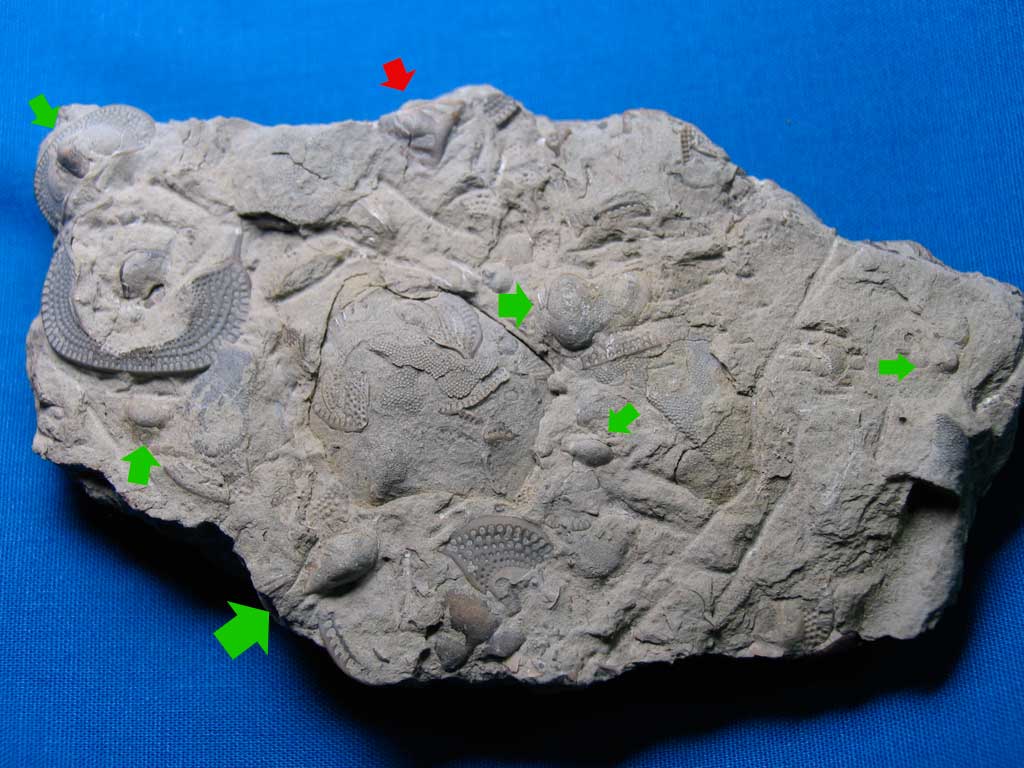
The Kope Formation of Carroll County, Kentucky produces a lot of Cryptolithus tessellatus fragments. This Ordovician Period trilobite was thought to be blind. Today's post is to highlight a part of the trilobite rarely found in this collecting location: the glabella. The center tear drop shape usually wears away from these probably molts. This shape can be seen in the first picture in the top left corner centered in the lace collar area.
The green arrows point to possible Cryptolithus glabellas in this rock plate. The red arrow points to pygidium of maybe a Flexicalymene.
Next picture shows the plate with a ruler to give one an idea of its size.
Thanks to Kenny for letting me use his air abrasion cleaning system to reveal more details of these trilobite fragments.
The green arrows point to possible Cryptolithus glabellas in this rock plate. The red arrow points to pygidium of maybe a Flexicalymene.
Next picture shows the plate with a ruler to give one an idea of its size.
Thanks to Kenny for letting me use his air abrasion cleaning system to reveal more details of these trilobite fragments.
Labels:
Kentucky,
kope formation,
ordovician,
Trilobite
Subscribe to:
Posts (Atom)