Friday, June 4, 2010
Leptaena waldronensis Brachiopod
These Leptaena waldronensis brachiopod fossils have been cleaned with sand abrasion. They were found in the Waldron Shale of Clark County, Indiana. The creatures existed in the Silurian Period. See this link for information on the specimen at the Indiana State Museum Center for Science and Culture.
See earlier blog posting showing the Leptaena acuticuspidata of Lower Devonian Period found in Tennessee.
This link to a May 4, 2010 blog posting on the Leptaena rhomboidalis of Devonian Period found in Clark County, Indiana.
Labels:
brachiopod,
indiana,
silurian,
waldron shale
Thursday, June 3, 2010
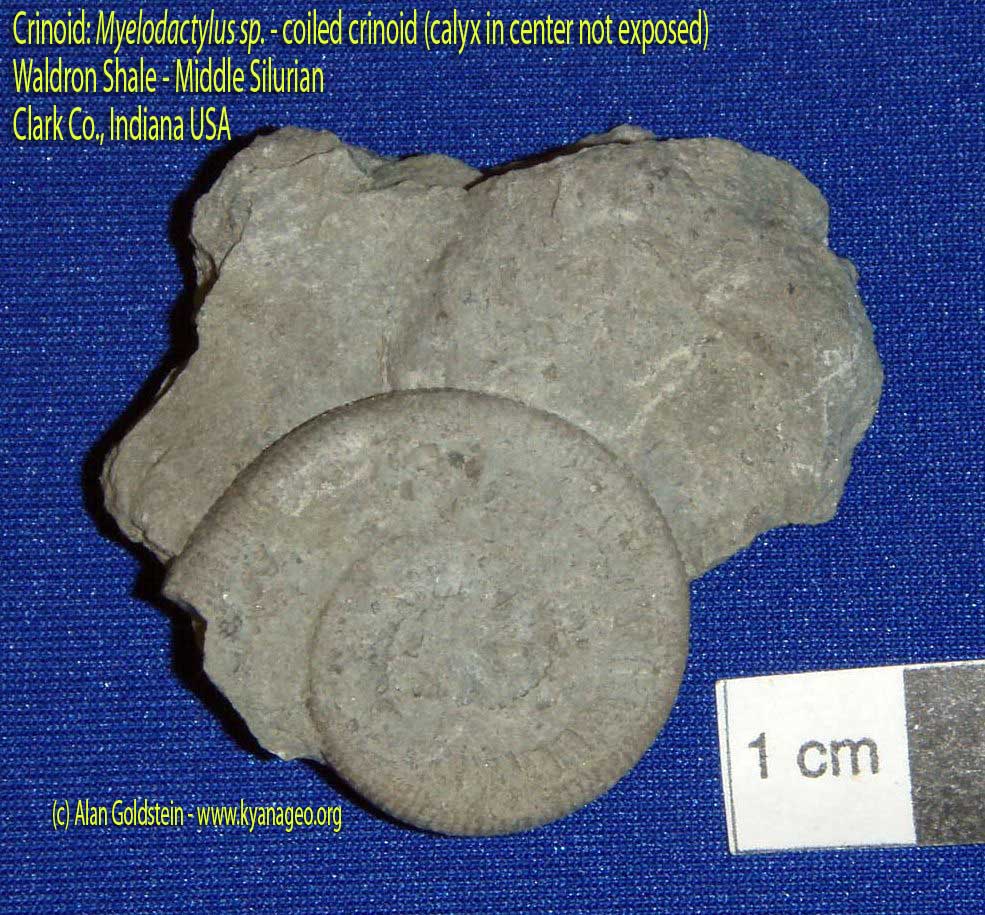
Silurian Myelodactylus Crinoid Prepped
Silurian Period Myelodactylus convolutus crinoid arm/stem fossil found in the Waldron Shale of Clark County, Indiana, USA. This fossil has been prepped with air abrasion cleaning. The rock this fossil is in is pretty hard and is difficult to remove.
Update (08/03/2010): This might be part of a Myelodactylus crinoid. See something like it on the KYANA Geological Society web site and the Indiana Memory Collection site. (11/20/2013) The calyx is in the center of the coiled section -- must be small. Thanks to Alan for the explanation.)
Update (02/16/2020): Kenny was able to provide a species name. Learn more about this unique crinoid from this article Myelodactylid crinoids from the Silurian of the British Isles by Stephen K Donovan and George D Sevastopulo from 1989 Palaeontology Volume 32 pages 689-710 at https://www.biodiversitylibrary.org/part/173971#/summary Plate 81 shows clear examples of what the calyx looked like though it might be somewhat different in the species of this fossil.
The picture below where the fossil still has water on it shows some sort of detail of a series of plates the inner spiral is resting on.
See some of the best Waldron Shale fossils on display on the Internet at Bob Schacht's web site at this webpage. The pictures of the Lyriocrinus crinoid calyx are amazing, described as "probably the finest crinoid ever to be found in the Waldron Shale Formation." :)
As always if you want to see some remarkable fossils from Indiana in person, visit the Indiana State Museum at 650 West Washington Street, Indianapolis. They have a truly amazing display of Crawfordsville, Indiana crinoids. Their database contains a number of Waldron Shale crinoids as well viewed at this web page.
Labels:
crinoid,
indiana,
silurian,
waldron shale
Wednesday, June 2, 2010
Bumastus niagarensis Trilobite
Earlier in the year, I posted an image of this Bumastus niagarensis (originally described in 1879 as Illaenus niagarensis) when it was found (see Waldron Shale Trilobites). It has now been cleaned with sand abrasion and exposed more with an engraver. It was found in the Waldron Shale of Clark County, Indiana which means it existed in the Silurian Period. The cephalon of this Bumastus niagarensis is about 30 mm wide.
Below is a visual comparison of the same fossil before and after cleaning (click on image to enlarge). This trilobite as some eerie looking eyes and interesting patterns on its outer plates. These types of fossils are fun to prep because of the rapid and noticeable progress when cleaning. Thanks to my cousin for letting me use the cleaning tools.
Fossil preparer Marc Behrendt has posting a very nice article on his website entitled: Trilobites of the Rochester Shale. When he describes the Bumastus ioxus of the family Styginidae, a comment is made that "the outer edge of the exoskeleton preserved the best, the central portions of the trilobite seemed to possess no or very thin exoskeltons."
The specific features of the Bumastus niagarensis noted by Whitfield were: "cephalon rather convex, with long dorsal furrows, no lip or concave border on the cephalon. Eyes of medium size, situated nearly their own length from the posterior margin, thorax short, pygidium long, rather pointed behind, with narrow concave border."
As of the writing of this blog post, one can buy Bumastus trilobites from the Rochester Shale Formation of Middleport, New York at this web page on the Indiana9Fossils site. Their fossils are more intact than this one but were smaller trilobites. Also looking at the pictures the fossils appear to be coated with some sort of sealer.
They also have a prepared Calymene breviceps trilobite found in the Waldron Shale of Indiana for sale.
In addition, the Indiana State Museum has 55 Bumastus trilobites pieces listed in their collection database. They appear to be fragments collected from Blackford County, Indiana. If you are in the Indianapolis area visiting and like fossils, they have some great geology and paleontology displays.
Below is a visual comparison of the same fossil before and after cleaning (click on image to enlarge). This trilobite as some eerie looking eyes and interesting patterns on its outer plates. These types of fossils are fun to prep because of the rapid and noticeable progress when cleaning. Thanks to my cousin for letting me use the cleaning tools.
Fossil preparer Marc Behrendt has posting a very nice article on his website entitled: Trilobites of the Rochester Shale. When he describes the Bumastus ioxus of the family Styginidae, a comment is made that "the outer edge of the exoskeleton preserved the best, the central portions of the trilobite seemed to possess no or very thin exoskeltons."
Image from Plate 1, Figure 3 - by E.N. Fischer, Del.
Bumastus niagarensis (Whitfield) Wauwatosa, Wisconsin
New and Old Silurian Trilobites from Southeastern Wisconsin, with
Notes on the Genera of the Illaenidae
by Percy E. Raymond
Bulletin of the Museum of Comparative Zoology at Harvard College
Volume LX No. 1 - January 1916
This next image shows the cephalon from the front and how its one side is still embedded in the matrix. The white area reveals activity of the engraver trying to remove matrix to reveal more of the other eye and rest of cephalon. The front is damaged and the shell is gone.
The specific features of the Bumastus niagarensis noted by Whitfield were: "cephalon rather convex, with long dorsal furrows, no lip or concave border on the cephalon. Eyes of medium size, situated nearly their own length from the posterior margin, thorax short, pygidium long, rather pointed behind, with narrow concave border."
Image from Plate 1, Figure 10 - by E.N. Fischer, Del.
Bumastus dayi Raymond - Wauwatosa, Wisconsin
New and Old Silurian Trilobites from Southeastern Wisconsin, with
Notes on the Genera of the Illaenidae
by Percy E. Raymond
Bulletin of the Museum of Comparative Zoology at Harvard College
Volume LX No. 1 - January 1916
As of the writing of this blog post, one can buy Bumastus trilobites from the Rochester Shale Formation of Middleport, New York at this web page on the Indiana9Fossils site. Their fossils are more intact than this one but were smaller trilobites. Also looking at the pictures the fossils appear to be coated with some sort of sealer.
They also have a prepared Calymene breviceps trilobite found in the Waldron Shale of Indiana for sale.
In addition, the Indiana State Museum has 55 Bumastus trilobites pieces listed in their collection database. They appear to be fragments collected from Blackford County, Indiana. If you are in the Indianapolis area visiting and like fossils, they have some great geology and paleontology displays.
Labels:
indiana,
silurian,
Trilobite,
waldron shale
Subscribe to:
Posts (Atom)